Muscle Has Always Been Ours: Reclaiming the Strength That Society Tried to Make Shameful
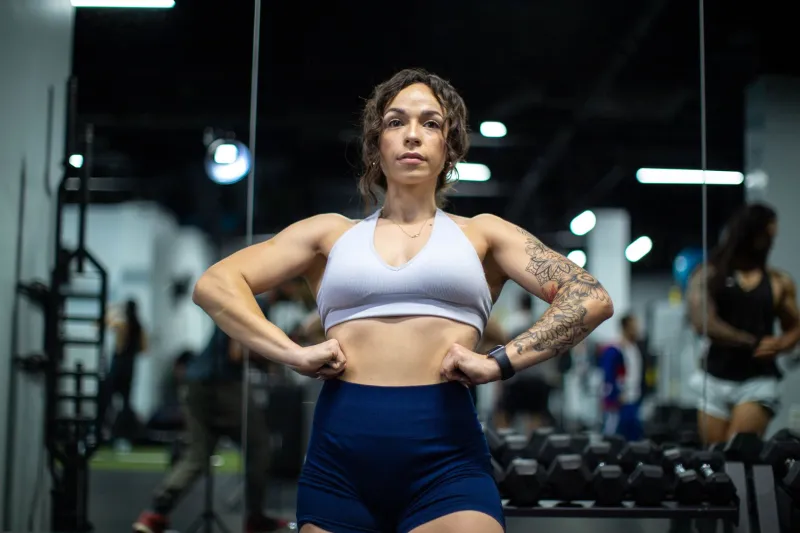
There's a moment a lot of muscular women of color know intimately. You're somewhere ordinary — a family cookout, a work meeting, a first date — and someone clocks your arms, your shoulders, the way your back moves under your shirt. Their face does something complicated. Not quite admiration. Not quite discomfort. Something in between that you've learned to read like a second language.
That look has a history. And unpacking it is just as important as any PR you've ever hit in the gym.
The Beauty Standard Nobody Admitted Was Racialized
For decades, mainstream fitness culture sold women a very specific aspiration: lean, lightly toned, soft enough to still seem approachable. Think the early 2000s obsession with "long and lean" yoga bodies, or the relentless marketing of tiny weights and endless cardio to women who were told that anything heavier would make them "bulky."
That standard was never neutral. It was built on a very particular image of femininity — one that centered whiteness, delicacy, and smallness as the default for what a woman's body should look like when she works out. Women of color, particularly Black and Latina women, were already excluded from that image before they ever touched a barbell.
Here's the cruel irony: when Black women's bodies naturally carry more muscle mass — a difference backed by research showing higher skeletal muscle index in Black women compared to white women — that same feature gets coded as unfeminine, aggressive, or "too much." The standard was designed so that our bodies would fail it either way.
"You Look Like a Man" and Other Things People Say When They're Afraid of You
Ask any visibly muscular woman of color and she'll have a catalog of comments. From strangers, from coworkers, from aunties who mean well and cousins who don't. "You're getting too big." "Men don't like that." "You looked better before." Sometimes it comes wrapped in concern. Sometimes it comes out as a joke. Either way, the message is the same: your strength makes other people uncomfortable, and that's supposed to be your cue to shrink.
What rarely gets named is the racial dimension layered underneath the sexism. When a white woman competes in powerlifting or posts her deadlift on Instagram, she's often celebrated as breaking barriers, as a badass defying expectations. When a Black woman does the same, she's more likely to be compared to a man, accused of using performance-enhancing drugs, or reduced to a stereotype about Black women's bodies being "naturally" built for labor. The exoticization and the dismissal come from the same place: a refusal to see muscular women of color as fully, complexly feminine.
And in professional spaces? It gets more layered still. Research on workplace bias has consistently shown that Black women are penalized for traits perceived as aggressive or dominant — and a visibly strong body can become part of that projection. Your physical presence becomes something you have to manage on top of everything else.
What Building Muscle Actually Does to Your Sense of Self
Here's what the discomfort brigade doesn't get to take from you: the internal shift.
Women who strength train consistently report something that goes way beyond aesthetics. There's a psychological recalibration that happens when you learn what your body can do. When you hit a lift you've been chasing for months, when you feel your glutes fire during a hip thrust, when you look in the mirror and recognize power instead of flaw — something fundamental changes about how you move through the world.
For women of color, that shift can be especially profound because so much of our relationship with our bodies has been shaped by external judgment. We've been told our hips are too wide, our features too bold, our presence too loud. Strength training — real, progressive, heavy strength training — has a way of interrupting that narrative at the source. You stop asking whether your body is acceptable and start asking what it's capable of.
That's not a small thing. That's a complete reorientation.
The Exoticization Problem Nobody Talks About Enough
There's a flip side to the dismissal, and it's just as damaging. Sometimes muscular women of color aren't erased — they're fetishized. Reduced to a body type. Celebrated in ways that strip out personhood and replace it with spectacle.
You see this in how fitness media uses images of Black and brown women's bodies as visual shorthand for "power" or "rawness" without actually platforming those women's voices or experiences. You see it in the way certain body types get celebrated in hip-hop culture but policed in professional spaces — as if our strength is only acceptable when it's entertaining someone else.
Navigating that tension is exhausting work that white women in fitness largely don't have to do. Being visibly muscular as a woman of color means constantly negotiating between invisibility and spectacle, between being told you're too much and being consumed as a brand aesthetic.
Choosing Your Body Anyway
None of this means you stop lifting. None of this means you dial back your goals to make someone else's worldview more comfortable. What it means is that you get to build your body with your eyes open — knowing what you're up against, understanding the history, and choosing yourself anyway.
Your muscle is not aggression. It's not a phase. It's not a threat to your femininity or your desirability or your professionalism. It is evidence of work, of discipline, of a relationship with your body that belongs entirely to you.
The women who came before us carried incredible physical strength out of necessity — strength that was exploited, mythologized, and never honored the way it deserved. You get to carry yours differently. You get to carry it as a choice, as a statement, as something you built for yourself.
So the next time someone's face does that complicated thing when they look at your arms? Let them sit with it. You've got a workout to get to.